

From money matters to civic empowerment: Reframing financial literacy in Bratislava
June 24, 2025
By Petra Ignjatović (Znanje na djelu) and Fidelis Kwadwo Nketia (THE CIVICS Innovation Hub)
“Financial education goes beyond just money. It connects with culture, family orientations, personal commitments and the broader norms and values of our societies.“
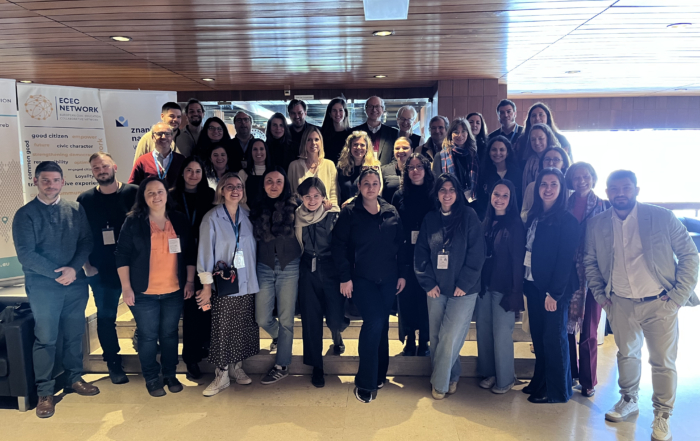
This was the unilateral understanding that emerged across discussions when from 3–5 June 2025, in the heart of the Slovak capital, THE CIVICS Innovation Hub, in collaboration with Znanje na Djelu, the ERSTE Foundation’s FLiP, and with support from the German Federal Agency for Civic Education (bpb), hosted an intensive, cross-sectoral NECE Lab on Financial and economic literacy. As today’s world grows more complicated, citizens need solid know-how to manage personal, civic, financial, and economic issues. To meet that challenge, the Lab brought together educators, researchers, practitioners, and policymakers to ask a practical question: how can we weave financial and economic literacy into civic education so it genuinely empowers people?
Designing civic and financial solutions from the ground up
Over two intense working days in Bratislava, participants engaged in a deeply human-centred design thinking process guided by expert facilitator Helena Habdija. The goal was not to rush toward solutions, but to frame the right questions – questions that address real needs, challenge assumptions, and reflect the values and realities of diverse communities in finding the nexus between financial and civic education.
The Lab unfolded through several distinct stages:
- Participants were provided with material on how to define civic and financial challenges using robust research, combining desk-based inquiry with field interviews.
- Teams conducted interviews, designed surveys, and began validating their initial ideas with real-world input from their communities.
- Using the “problem tree” method, participants unpacked the root causes and consequences of financial literacy challenges.
- Storytelling, prototyping, and observation exercises helped visualise how these challenges manifest in everyday life.
- Teams presented their ‘Challenge Briefs’ – focused, research-backed summaries of a key issue in financial and civic education – to guide future innovation and intervention.
Each stage pushed participants to dig deeper, not only into the “what” of financial education, but the “why” and “how” that make it matter in the lives of real people.
Redefining financial literacy: Beyond budgets and balance sheets
At the heart of the discussions lay the question: What if financial education was never just about money – but about power, agency, and the co- creation of the kind of society we want to live in?
One quote from keynote speaker Dr. Mattias Björklund from the Stockholm University, a researcher specialising in social science education captured this nuance:
“Sometimes financial literacy is focused on results, but beyond that, the competencies needed to achieve those results in the first place are often overlooked.”
Dr. Björklund’s talk encouraged us to rethink financial literacy as a civic competency – a foundational skill that shapes how individuals participate in society, understand their rights and responsibilities, and make informed decisions in an increasingly monetised world. It also served as a powerful reminder of the crucial role we play, as civic educators, in supporting all stakeholders to develop the foundational competencies required to realise truly effective financial and civic education.
In addition, we heard inspiring inputs from practitioners in the field including our local partner FinQ Centrum, which has undertaken and developed a comprehensive financial and civic education programme in Slovakia, succeeding to reach multiple target groups and led to the integration of ‘FinLit’ into the country’s formal educational curriculum. Beyond that, winners from our recent Civic Innovation Fund (CIF) call on financial and economic literacy pitched their projects to the group and shared how they are actively reshaping the delivery of economic and financial education across Europe – from gamifying education to targeting often overlooked demographics including youth in rural and periphery areas, single parents and senior citizens.
Challenge briefs
The most tangible outcome of the Lab was the development of a set of Challenge Briefs – a compact, yet comprehensive articulation of a real financial literacy issue, based on quality research and cross-cultural team experiences and insights. These briefs were addressing some of the most compelling financial and civic education themes such as the intergenerational gap in understanding financial responsibility, the psychological toll of wealth comparison and the illusion of life fulfillment as well as the slow adaptability of education systems in meeting today’s financial literacy. Hence this, aims to serve as inspiration and guidance for future educators, innovators, and programme designers working at the intersection of civic and financial education.
The power of process over product
One of the most powerful aspects of the Lab was its emphasis on prioritising processes over immediate answers. In an era that often demands quick fixes, the NECE Lab offered a much-needed space to slow down, reflect, and dig into the why behind the what. Participants left with reflections on deeper questions, sharpened perspectives, and a renewed commitment to civic learning as a lever for justice and resilience.
The mix of national backgrounds and professional experiences strengthened each team’s work, turning the Lab into a practical space for shared learning and meaningful exchange.
The Bratislava Lab was just the beginning. The work of integrating financial literacy into civic education continues, and the next opportunity to deepen this conversation will be the NECE Festival 2025 in Oslo, taking place this autumn from 2-4 September. We invite all Lab participants, NECE community members, and anyone curious about financial and civic education to join this hands-on gathering of educators, practitioners, and changemakers from across Europe and beyond. Register here.
*This NECE lab was curated by THE CIVICS Innovation Hub in partnership with the ERSTE Foundation and FLiP.
** NECE is financially supported by the German Federal Agency for Civic Education | bpb and led by THE CIVICS Innovation Hub.
📸© Photo credits | Lukáš Klčo x THE CIVICS Innovation Hub
Latest news
Rethinking civic education through transformative experiences
Rethinking civic education through transformative experiences Insights from the NECE Lab in Lisbon July 1, 2026 By ...

Europe cannot educate for democracy as if the world has stayed the same
Europe cannot educate for democracy as if the world has stayed the same Reflections from a NECE & ...

Technology, politics, and practice
Technology, politics, and practice Understanding the civic gap May 4, 2026 By Kameliya Tomova and Mila Moshelova ...

HOPE in challenging times: Insights from the NECE Festival 2025
HOPE in challenging times Insights from the NECE Festival 2025 March 18, 2026 By Ole Jantschek, National Director of ...