

Navigating polarisation in conflict and post-
conflict societies
July 29, 2025
By Martin Kirbach
From 11–14 June 2025, Sarajevo became a space for deep reflection, dialogue, and exchange on one of the most urgent questions facing civic educators today: How do we work constructively with polarised groups, especially in post-conflict societies?
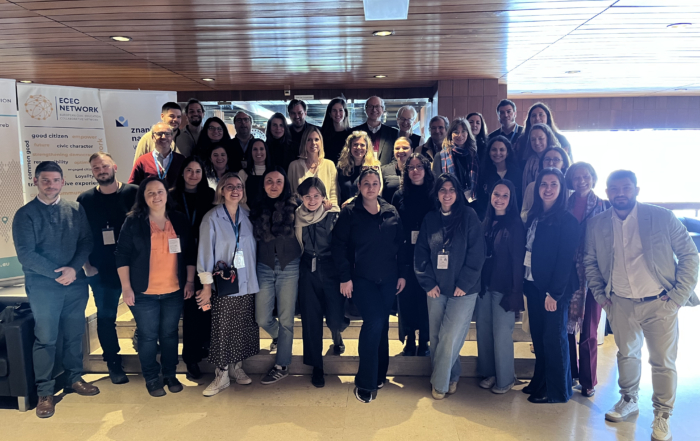
Hosted by THE CIVICS Innovation Hub in cooperation with EUSTORY and the Körber-Stiftung, the NECE Lab “Working with polarised groups in civic education” brought together a group of committed practitioners, researchers, and activists to explore affective polarisation – its forms, its causes, and how civic education might respond to it.
Understanding the nature of polarisation
The Lab opened with an online input by Bert Bakker, political psychologist at the University of Amsterdam, who offered a conceptual framework for understanding polarisation. He differentiated between affective, perceived, and opinion-based polarisation, and challenged the idea that polarisation is inherently harmful. “We often conflate polarisation with threats to democracy”, he explained, “but sometimes it reflects active, engaged disagreement – what matters is how we manage it”.
Bakker drew on empirical findings from his research on youth political development, highlighting how polarisation emerges in classrooms and what educators can do to address it. He closed with a simple but powerful provocation: “Are we, in Western Europe, truly able to listen and realise that we have more in common than we think?”
Building dialogue from the ground up
Lab participants explored their own experiences with polarisation in group exchanges, surfacing topics like brain drain and intergenerational divides, nostalgia for communism, increasing partisanship in education systems, and discrepancies in how international issues (such as the conflicts in Ukraine and Gaza) are discussed across Europe.
Laura Arikka of the Finnish TimeOut Foundation introduced a grassroots method for fostering structured dialogue across deep divides. With over 140,000 participants across Finland and beyond, including in post-conflict settings like Nepal, TimeOut has become a globally adaptable model. Arikka shared the principles behind the method, emphasising the need for “slow dialogue” that fosters listening before arguing and is rooted in real-life, local contexts such as schools, NGOs, and municipal offices.


Lived dialogue: The School for Peace approach
One of the Lab’s most emotionally resonant sessions was led by Roi Silberberg and Abeer Halabi from the School for Peace in Israel. Silberberg, an Israeli Jew, and Halabi, a Palestinian from the Druze community, co-facilitated a workshop that went beyond theory to let participants experience what dialogue feels like when power, history, and identity are in the room.
Rather than centring a specific conflict, the session focused on the core challenges of creating dialogue between groups with structural asymmetries. “We don’t argue about each other’s feelings – we respect them”, Halabi noted, “yet we must also name the roles we play in the conflict.” Participants were guided through experiential exercises that brought these complexities to the surface while maintaining a respectful, dialogic space.
Facing colonial legacies
A powerful parallel session, led by Miguel Barros and Noa Brighenti from the Portuguese Association of History Teachers, explored decolonisation as a lived experience. Rather than viewing decolonisation as a solely historical or political process, they encouraged participants to consider how it continues to shape individual identities and how young people, particularly those from formerly colonised and colonising communities, express these legacies through art and storytelling.
This session asked difficult but necessary questions: How do we discuss colonial history in classrooms that include both descendants of colonisers and the colonised? How can civic education contribute to both healing and justice?
Learning from the Western Balkans
In a session dedicated to the local context, Melisa Forić Plasto (EUROCLIO), Maja Vejzović (Local Democracy Agency Mostar), and other regional actors reflected on what it means to build democratic futures in post-war societies. Participants spoke candidly about the psychological weight of unresolved trauma, the ongoing influence of ethno-political division, and the structural paralysis created by the Dayton Agreement, often described as an “administrative monster”.
A particularly moving moment came when a speaker noted that they may come from different sides of a conflict, but PTSD (Post-Traumatic Stress Disorder) is something veterans on all sides share. This insight reframed trauma not as a dividing line, but as a shared human experience, and possibly a starting point for connection.
From shared struggle to shared strategies
The final day of the Lab provided space for peer-to-peer exchange. In an open forum, participants shared tools, practices, and lessons from their own work, ranging from methods for engaging marginalised youth to strategies for bridging divides in highly politicised classrooms.
Again and again, one insight re-emerged: Dialogue doesn’t start with the other – it starts with oneself. Before we can foster understanding across lines of division, we must first reflect on our own positions, assumptions, and roles in the systems we seek to change.
The NECE Lab Sarajevo did not seek quick fixes or definitive answers. It created space for courage, curiosity, and connection amidst deepening polarisation. It reaffirmed that civic educators are not just transmitters of knowledge, but builders of trust, facilitators of empathy, and steady forces for transformation – often working quietly, yet with lasting impact.
For further details on this NECE Lab we invite you have a read through the retrospect of the EUSTORY Network here.
For more information on NECE Labs and news on civic education in Europe, visit: https://nece.eu/nece-labs/.
*This NECE lab was curated by THE CIVICS Innovation Hub in partnership with EUSTORY and Körber-Stiftung.
** NECE is financially supported by the German Federal Agency for Civic Education | bpb and led by THE CIVICS Innovation Hub.
Latest news
Rethinking civic education through transformative experiences
Rethinking civic education through transformative experiences Insights from the NECE Lab in Lisbon July 1, 2026 By ...

Europe cannot educate for democracy as if the world has stayed the same
Europe cannot educate for democracy as if the world has stayed the same Reflections from a NECE & ...

Technology, politics, and practice
Technology, politics, and practice Understanding the civic gap May 4, 2026 By Kameliya Tomova and Mila Moshelova ...

HOPE in challenging times: Insights from the NECE Festival 2025
HOPE in challenging times Insights from the NECE Festival 2025 March 18, 2026 By Ole Jantschek, National Director of ...