

Navigating corporate civic responsibility
Insights from the NECE Lab in Vienna
December 17, 2025
By Martin Kirbach
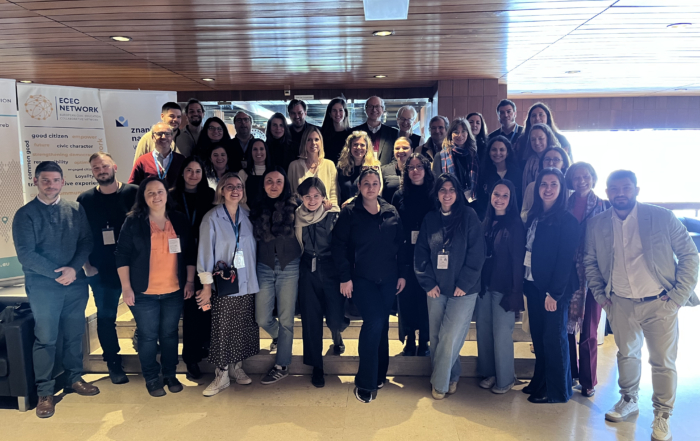
With Vienna’s year as European Capital of Democracy nearing its close, 25 professionals from across Europe came together at ERSTE Campus of the ERSTE Stiftung for the NECE Lab on Corporate Civic Responsibility, a two-day exploration of how workplaces can become engines of democratic culture.
Hosted in collaboration with OekoBusiness Vienna, the Lab created a rare cross-sector space where business leaders, civil society actors, and public administrators met as co-learners — recognising that democracy does not end at the ballot box but extends deeply into our everyday professional and personal life.
The Lab opened with a straightforward observation:
We work in democratic societies, but our organisations often operate with very little democratic practice.
Over two days, participants examined how companies can foster dialogue, participation, ethical leadership, and civic responsibility as strategic investments in resilient teams and healthier societies.
Stefan Sindelar, CEO of the European Capital of Democracy initiative, set the stage by sharing Vienna’s experience designing participatory and multi-stakeholder projects at the city scale. His message: democratic innovation grows where institutions, citizens, and businesses meet as partners.
A highlight of Day 1 was the panel featuring Kenneth Amaeshi (EUI), Vivienne Koch (Akkodis) and Péter Rendes (InnoTeq) — each offering a different entry point into corporate civic responsibility.
Discussions spanned global governance, inclusive leadership, and the role of SMEs in strengthening local democratic ecosystems. The central question:
Is democracy good business?
The consensus: yes. Organisations with transparent decision-making, diverse teams, and a sense of responsibility toward their communities are more trustworthy, resilient, and competitive in the long run.
Two hands-on workshops formed the backbone of this Lab:
Ubuntu: Building ethical leadership & Democratic teams
Led by facilitators from IPAV, this session immersed participants in the Ubuntu philosophy — I am because you are — highlighting self-knowledge, resilience, empathy, and service as core leadership principles. The workshop emphasised the metaphor of bridge-building and invited participants to reflect on how relationships and team cultures shape democratic practice.
Good conversation training
On Day 2, the New Community Foundation introduced tools to counter polarisation through curiosity-driven dialogue. Participants practiced listening fully, articulating disagreement respectfully, and navigating tension as well as learned the difference between conversation and discussion — skills essential to any democratic workplace.
A consistent takeaway emerged: good conversations are not soft skills — they are civic skills.
Key Takeaways from the NECE Lab
- Democratic culture is a strategic asset. Companies with inclusive, participatory internal cultures are better equipped for uncertainty, innovation, and trust-building.
- Corporate civic responsibility goes far beyond CSR. It is about enabling employees to act as informed citizens and supporting conditions for good governance.
- Leadership development is democracy work. Ubuntu’s focus on empathy, resilience, and service aligns directly with democratic competencies.
- Dialogue is an organisational infrastructure. Learning how to converse constructively is essential for teams facing complexity and polarisation.


3 Questions – 3 Minutes with Kenneth Amaeshi
As part of our 3q3m format, we spoke with Professor Kenneth Amaeshi, a leading thinker on sustainable governance and the architect of the Africapitalism framework.
1. What does corporate civic responsibility mean to you, and how can businesses move beyond compliance to strengthen democratic culture?
“Corporate civic responsibility, for me, is about how companies can encourage their employees and stakeholders to become more involved in political and civic life. Governments are ultimately a reflection of the people who constitute them. So, if businesses help people develop the ability to make good choices — without telling them what to choose — they indirectly strengthen institutions and governance. A stable, well-governed society is an enabling environment for business. Supporting citizens in making thoughtful decisions is therefore both a civic duty and a strategic interest.”
2. Your work on Africapitalism highlights a human-centred, community-oriented approach to business. How can this perspective inspire European companies?
Africapitalism rests on four pillars:
Prosperity: business must be profitable—this is not anti-profit.
Parity: prosperity must be shared; inequality must be addressed through inclusive value creation.
Harmony: companies must operate in peace with society and the environment.
Belonging: businesses should be rooted in the communities they operate in.
Globalisation has made many firms “placeless”, moving wherever profit is highest. Africapitalism challenges that mindset. Wherever you do business should be treated as home. If companies in Europe saw themselves as part of their local communities rather than temporary beneficiaries they would approach growth differently: not extractively, but collaboratively and with long-term commitment.”
3. Why is it important for business leaders and civic actors to come together in spaces like this NECE Lab?
“Because we often sit in our own bubbles without realising we are ultimately working toward the same goals. When I bring business leaders and government officials together, they start from different assumptions but end up recognising that both seek to meet people’s needs. Spaces like this NECE Lab serve as a reality check and a co-creation platform. They remind us that we are all citizens — whether we work in government or the private sector. By thinking together, we can build a better world more effectively than by acting in silos.”
Looking ahead
The Vienna Lab is part of a growing European effort to rethink the role of workplaces in democratic resilience. Through programmes like ReLEAD, launching in 2026, THE CIVICS will continue exploring how civic education, leadership development, and organisational culture intersect.
*This NECE lab was curated by THE CIVICS Innovation Hub in partnership with OekoBusiness Vienna.
** NECE is financially supported by the German Federal Agency for Civic Education | bpb and led by THE CIVICS Innovation Hub.
Latest news
Rethinking civic education through transformative experiences
Rethinking civic education through transformative experiences Insights from the NECE Lab in Lisbon July 1, 2026 By ...

Europe cannot educate for democracy as if the world has stayed the same
Europe cannot educate for democracy as if the world has stayed the same Reflections from a NECE & ...

Technology, politics, and practice
Technology, politics, and practice Understanding the civic gap May 4, 2026 By Kameliya Tomova and Mila Moshelova ...

HOPE in challenging times: Insights from the NECE Festival 2025
HOPE in challenging times Insights from the NECE Festival 2025 March 18, 2026 By Ole Jantschek, National Director of ...