

Notes from the Istanbul Lab on Trust and Polarisation
December 18, 2025
By Kameliya Tomova
For years, our work at THE CIVICS has been shaped by close collaboration with civic education practitioners who develop concepts to help create common ground through dialogue. This includes partners such as Maja Nenadović and others working with practical tools such as the DARE Educators’ Guide. As this practice has matured, it has raised a more demanding set of questions. What happens when dialogue encounters deep mistrust? How do polarisation and declining trust reinforce one another, and under what conditions does dialogue lose its civic value — or cease to be appropriate at all? To address these questions, and as a step towards NECE’s 2026 focus on TRUST, we have begun to look more closely at the theoretical underpinnings of this work. From 2026, a new EU-funded project by THE CIVICS under the name of COMPASS will support civic educators with dialogue methodologies and case studies across fields such as human rights, financial, economic and digital literacy, climate change, and EU values. The Istanbul Lab marked an early moment in this shift — a space to test assumptions, refine concepts, and examine what trust and polarisation mean when translated into civic practice.
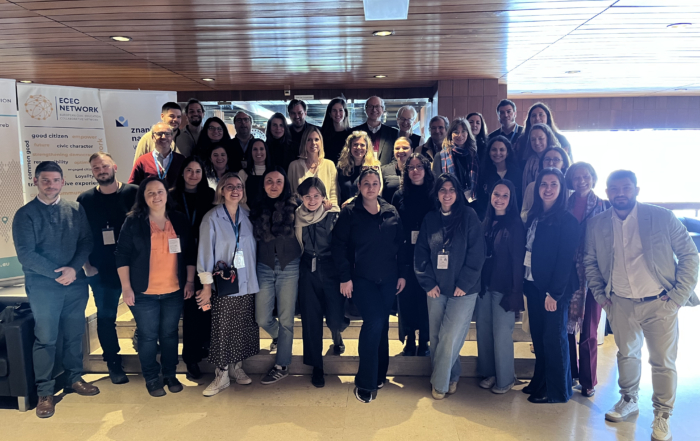
On 10–11 October in Istanbul, THE CIVICS Innovation Hub and the European School of Politics brought together practitioners, scholars and thought leaders to examine the conditions shaping trust and polarisation in our societies today. The Lab was designed as a deliberative space for open-ended exchange and it served multiple aims: to sharpen the questions we ask, to clarify the definitions we use, and to open a wider conversation within the civic education field about what trust and polarisation actually mean in practice. This Lab marked the first step toward NECE’s 2026 focus on trust — a theme that will anchor next year’s European civic education festival, along with a series of labs and online campus sessions exploring these issues from multiple angles.
Our progress in Istanbul was incremental, with each contribution at the lab adding a distinct perspective and outlining areas for further work. The group began by considering what ‘trust’ means — who we place it in, and what structures enable or undermine it. Mark Freeman, who leads a global initiative on depolarisation, argued that trust cannot be understood separately from distance and radicalisation. “Polarisation is a hyper-problem,” he said, meaning that it prevents us from resolving any other issue. According to him, polarities are about distance, and radicalisation adds momentum and intensity to that distance. When both take hold, societies begin to fragment and pull apart. This concern was echoed by Michael Schwarz, Managing Director of the Baden-Baden Entrepreneur Talks, who warned that mistrust between citizens carries deeper risks than institutional scepticism. “The most dangerous form of mistrust is not distrust in institutions or politicians, but the assumption that our fellow citizens are not well-meaning — even without any observed behaviour. When mistrust becomes an untested belief about ‘the other’, polarisation hardens long before dialogue begins,” said he.


Peter Levine, political theorist and civic scholar, cautioned against treating all forms of division as equivalent. “Is the problem that two sides are too far apart,” he asked, “or that one side is organised around hate and the other around love and dignity?” The answer to that question, he suggested, has profound consequences for whether and how we even attempt dialogue. Levine argued that not all polarisation reflects symmetrical extremes — sometimes one side advances exclusion while the other defends basic rights. In such cases, the work of bridging may look very different, or may not be appropriate at all.
Building on this concern, human rights and peace activist Harsh Mander warned that insisting on symmetry between “sides” can normalise authoritarian or dehumanising positions. Drawing on his experience in India, he asked: “If I say Muslims deserve to live with dignity, and that’s seen as an ‘extreme’ view, then what is the centre? Mild dehumanisation?” The language of depolarisation and how broadly it’s currently being used, he argued, risks collapsing injustice into mere disagreement if moral asymmetries are not explicitly acknowledged.
Others spoke of perception gaps — the distance between what we think others believe and what they actually do. When people have limited direct contact and rely instead on distorted signals from online spaces, they tend to assume others hold more extreme and internally consistent positions than is often the case. Peter Levine noted that quantitative research frequently reinforces this assumption by treating political identities as coherent blocks — for example, presuming that someone who holds a conservative position on one issue will do so across others. In practice, he argued, people’s views are far more fragmented and situational. These misperceptions reduce willingness to cooperate, until direct interaction or clearer information disrupts the assumed coherence of the “other side”.
A recurring theme was the role of storytelling in communicating trust and in constructing its very possibility. If people are more likely to trust narratives that acknowledge them — that reflect their pain or aspirations — then storytelling becomes foundational to civic life. Laura Kelly, a professor of journalism, noted that “journalism today is often binary, incendiary, reductive.” But reframing narrative work as a civic practice could offer a new form of trust-building. “It’s about who we talk about, and who we leave out,” she said, “and what world we construct through our telling.”


Kumi Naidoo, civil society leader and climate-justice advocate, noted that democracy’s failures are not recent. “The US did the world a disservice,” he said, “by promoting a notion of democracy that didn’t resonate even with its own people, ” pointing to widening inequality, corporate money in politics, racial injustice and weak social protection. He also warned that many democratic failings stem from structural exclusions even inside our own institutions as civil society advocates. He noted that international NGOs and political systems often replicate the same inequalities they claim to confront, through decision-making structures in which financial power effectively determines influence, as well as leadership cultures that sideline those most affected by injustice. These patterns, he suggested, erode trust long before polarisation becomes visible. They also make any conversation about repair incomplete when those who carry the heaviest consequences are absent from the room.
The final hours of the Lab turned to the practical conditions that shape trust in democratic settings. It was noted that participation processes often create mistrust when they do not lead to visible outcomes. Several pointed to previous national and European consultations in which extensive public input produced little institutional follow-through, reinforcing perceptions that engagement is symbolic rather than substantive.
Reflecting on long-term leadership programmes, Michael Schwarz noted that trust does not emerge from persuasion but from carefully designed encounters: “What we’ve learned is that confronting people with what they don’t know rarely changes how they think. What does is creating the conditions for serious conversation — spaces with clear rules, real diversity, and the courage to bring people into contact with lives they would otherwise never encounter.”
Others described how political actors can actively erode trust by targeting specific groups, weakening judicial safeguards, discrediting journalism, and restricting civil society. In contrast, the discussion pointed to democratic practices that retain credibility when they are designed with clear mandates and accountability, including citizens’ assemblies, participatory budgeting, and forms of commons-based governance. Speakers emphasised that such practices cannot succeed in isolation unless they also confront the structural drivers of distrust — particularly economic inequality and the deliberate instrumentalisation of social divisions.
Participants noted that mistrust deepens where political and economic conditions constrain people’s capacity to act collectively. Widening inequalities, the concentration of wealth, and declining access to social and political capital were identified as factors that reduce the space for negotiation and shared problem-solving. Several contributions also pointed to economic models centred on perpetual growth, which intensify environmental degradation and social strain, creating conditions in which fear and resentment can be readily mobilised.
The discussion extended to the role of unresolved or selectively addressed histories — including the absence of serious engagement with past violence, authoritarianism, or injustice — and how this shapes public attitudes in the present. Such gaps are often instrumentalised to justify exclusion, normalise discrimination, or weaken institutional oversight. These dynamics were presented as interconnected pressures that influence how societies understand conflict, responsibility, and the possibility of common ground.
The Lab closed with the acknowledgment that the issues raised require sustained inquiry. Participants emphasised the importance of examining how democratic norms evolve under conditions of rapid technological change, shifting geopolitical realities, and increasingly fragile information ecosystems. The conversation suggested that future work should focus on institutional design, accountability mechanisms, and practices that enable participation without replicating existing inequities. The next phase of NECE’s focus on TRUST will build on these discussions as a basis for further analysis and experimentation. The aim is to understand the conditions under which trust can emerge and to recognise the limits of consensus in complex and unequal societies.
*This NECE lab was curated by THE CIVICS Innovation Hub in partnership with the European School of Politics.
** NECE is financially supported by the German Federal Agency for Civic Education | bpb and led by THE CIVICS Innovation Hub.
Latest news
Rethinking civic education through transformative experiences
Rethinking civic education through transformative experiences Insights from the NECE Lab in Lisbon July 1, 2026 By ...

Europe cannot educate for democracy as if the world has stayed the same
Europe cannot educate for democracy as if the world has stayed the same Reflections from a NECE & ...

Technology, politics, and practice
Technology, politics, and practice Understanding the civic gap May 4, 2026 By Kameliya Tomova and Mila Moshelova ...

HOPE in challenging times: Insights from the NECE Festival 2025
HOPE in challenging times Insights from the NECE Festival 2025 March 18, 2026 By Ole Jantschek, National Director of ...