

NECE Festival HOPE: A Recap
September 25, 2025
By Kameliya Tomova
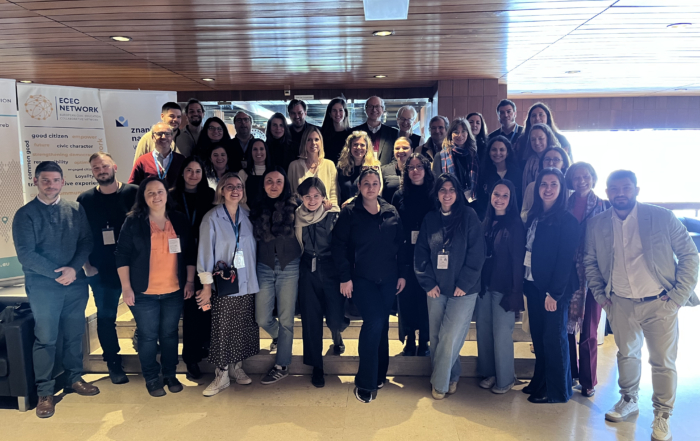
In Oslo, close to 300 civic educators, practitioners, and thought-leaders from 40 different countries gathered to test a demanding idea: hope can be practised as a civic skill. Across discussion panels, masterclasses and open spaces, the NECE Festival sketched a working definition of hope as a civic discipline – a practice of imagination, courage and care that can be taught, trained and applied in public life.
Opening the festival, Oslo’s Mayor Anne Lindboe reframed citizenship as daily work. She put it bluntly:
“Democracy, human rights, freedom – none of these maintain themselves. They require a continuous effort.”
Anne LindboeMayor of Oslo

Thomas Coombes, the strategist behind hope-based communications, set out in his keynote: our systems rest on a myth. “There’s this idea that we’re all rational decision makers who just mechanically follow the laws and do what we’re told.” In reality, “The vast majority of our decision-making is subconscious and emotional.” Neuroscience, he added, tells us that “empathy and kindness are muscles we can train,” creating “new rituals of democracy, new practices, new habits to build these things in society…” Thomas also warned about the easy slide into performance outrage – “It’s a danger in this world that cynicism overtakes healthy skepticism… we get a lovely little hit of dopamine on our brain, it feels good” – and about the trap of amplifying what we oppose: “If all we do is repeat it, even to sort of condemn it, we risk repeating it.” The “hope-based” alterntive he suggested is “to put out our vision and our values of how things could be, how we want things to be if we’re going to bring about that change” – which in practice means naming and picturing the future we’re building, showing people what it looks like, and arranging everyday routines so they can take part.
The festival’s masterclass on “Imagination Activism” with Phoebe Tickell – scientist, systems thinker and founder of Moral Imaginations – provided valuable evidence for imagination’s potential as a civic infrastructure. Participants strengthened their ‘moral imagination’ through collective visioning and guided practices that stretched perceptions of what is possible. Imagination Activism, as framed here, is a radical and rigorous approach that shifts us from reaction to creation – moving beyond fighting the old to actively bringing the new into being. The work offered portable tools for everyday use: exercises to surface multiple futures, prompts that widen who gets to design solutions, and routines that make scenario-building a habit. The organising principle was agency – if learners can rehearse different futures safely, they can help build them in public.
Jon Alexander – author of CITIZENS – showed what the shift looks like in practice. His masterclass, “Unlocking citizen power: The three principles of participatory organisations”, gave educators and organisers a toolset built around Purpose, Platform and Prototype:
- Purpose – say clearly what you’re for so people can meaningfully join.
- Platform – build the stage for others to act.
- Prototype – work in public with small, testable steps that give citizens a say from the start.
Participants left with sharp question sets for idea generation, case studies from campaigns that handed real decisions to communities, and design moves that shift organisations from doing things for people to building with them – where participation culminates in decision-making, not just consultation.
In their masterclass on “hope-based communications”, Thomas Coombes and Kristin Dannevig shared a straightforward way to speak about change by focusing on what we’re for, not only what we’re against. Participants were introduced to the five hope-based shifts and showed how these can sit inside everyday teaching and campaigning – for example, moving from naming threats to naming outcomes, from pointing at villains to pointing to values, and from problem talk to possibility.


Sofija Todorović of the Youth Initiative for Human Rights Serbia brought the conversation down to the street level of post-conflict societies. Reconciliation, she argued, requires justice – and it also requires trust – and neither arrives by accident. As she put it: “Resilience is not something you’re born with. It’s a choice we keep making, together.” Trust, in her framing, is built in “small, stubborn acts – showing up with people you were taught to avoid, and staying long enough to work together.” That dual emphasis – accountability and relationship-building – threaded through other festival panels on global citizenship and case studies from Ukraine to Utøya’s transformation into a site of remembrance and democratic learning.
There were also quieter lessons. The Bishop of Oslo, Sunniva Gylver, spoke about “religion” as religare, to bind again – and defined hope as something we do together through words and deeds. Her advice on resilience: focus deliberately on courage and goodness; accept we can’t control everything; build small daily rituals that steady us. Do the practice every day, hand over what overwhelms you and stay present for each other.
Writer and historian Philipp Blom closed on an uncomfortable truth: Europe has mislaid its shared project and treats the future as a threat – better an everlasting present than change that might take something away. That stance is untenable. Real shifts rarely arrive as thunderclaps; they are the harvest of patient groundwork. The suffragettes looked like failure for two generations, yet their arguments lodged in society so that, when instability came in 1918, the ground was prepared. Blom’s invitation: build the infrastructure of change now – arguments rehearsed in public, habits that hold under pressure, relationships that outlast a news cycle. Allow for hand-offs and missed targets; in stable times you plant, in volatile times the seeds move. Remember our own precedent – post-war Europeans rebuilt the impossible into the ordinary – and pair creativity with solidarity so uncertainty does not paralyse. Hope, as Václav Havel put it, is “an orientation of the heart”; in practice it means working for what is right even when the odds are indifferent. We cannot predict the future, but we can make ourselves ready for it.


Towards trust
At Oslo’s majestic Deichman Library, our “Ground-up democracy” panel paired European youth data with Norwegian practice. Alessandra Cardaci of Friends of Europe set the scene – a Brussels think tank bringing citizens’ voices into policy – with findings from a 2,000-person survey: low trust in politicians and media, high demand for spaces to meet, and clear fixes named by young people – education and tackling inequalities, among others. Thomas Berman, the CEO of SoCentral showed one such space in action: a national citizens’ assembly on Norway’s wealth fund, lottery-selected, briefed by experts, and tasked with recommendations – not to replace elections, but to supplement them. Citizen assembly member Jonas Krogh described the shift from positions to shared values – what kind of Norway do we want? – and how strangers, aged 16 to 81, found surprising agreement. The lesson of it all: combine representative democracy with deliberative forums, give citizens real stakes early, and make the process legible end-to-end.
On the third and final day, we celebrated our space – the NECE space – as a working community: a builder’s yard. Twenty-six open-space sessions produced proposals and pledges that now need follow-through, guided by our hope-based approach, which opens so many possibilities.
Next year, we will come together again to see which seeds have grown in this garden – and which pathways will help us tackle the topic of TRUST.
Trust is a set of behaviours and institutional designs that lower the cost of cooperation. It grows when people keep small promises, when processes are transparent, and when power is shared in ways that are legible and durable. The closing panel of the NECE Festival – Caroline Hornstein Tomić, Pedro Calado, Philipp Blom and Tanja Murphy-Ilibasic – made it concrete, showing that trust starts with listening beyond labels and extends to arrangements that give civil society, institutions and business real stakes in common outcomes.
Join the NECE Festival: TRUST in Lisbon, 14–16 October 2026, to learn – and apply – how civic education makes this intent real.
***
* NECE Festival 2025: HOPE was organised in cooperation with The European Wergeland Centre (EWC)
** NECE is financially supported by the German Federal Agency for Civic Education | bpb and led by THE CIVICS Innovation Hub.
Participants about the festival:
“Both masterclasses I joined were truly packed with actionable takeaways that I can put at work right away.”
“The whole festival reminded me that gathering with diverse yet values aligned people is so powerful, that storytelling and imagination are needed in all arenas, and that hope and grief must live, acknowledged, alongside each other to move forwards effectively.”
“We leave the event with renewed HOPE that local action, grounded in rights and participation, can build more resilient and just societies across the Balkans and beyond.”


View the full gallery here.
Latest news
Rethinking civic education through transformative experiences
Rethinking civic education through transformative experiences Insights from the NECE Lab in Lisbon July 1, 2026 By ...

Europe cannot educate for democracy as if the world has stayed the same
Europe cannot educate for democracy as if the world has stayed the same Reflections from a NECE & ...

Technology, politics, and practice
Technology, politics, and practice Understanding the civic gap May 4, 2026 By Kameliya Tomova and Mila Moshelova ...

HOPE in challenging times: Insights from the NECE Festival 2025
HOPE in challenging times Insights from the NECE Festival 2025 March 18, 2026 By Ole Jantschek, National Director of ...